

Picture yourself with three quotes landing in your inbox for Air Duct Cleaning.
One company will clean every vent in the house for a price that sounds like a typo, another wants several hundred dollars, and a third says it depends. Apparently, they can’t all be describing the same job, and usually they aren’t.
There is a PRICE to pay. 😉
Here is the short version of the prices in discussion.
Air duct cleaning costs for a typical home run about $300 to $700 for the whole system, according to national contractor pricing, with an average near $500 for a 2,000-square-foot house.
Yep, you read that right.
There may be a chance that your quote can land outside that range, because the price depends on system size, access, how dirty the ducts are, and what the job includes.
The number matters less than the scope behind it, so below we cover what shapes the price, how companies charge, and how to compare written estimates fairly.
TL;DR
- Expect roughly $300 to $700 for a typical home, but treat that as a national estimate, not a New Jersey quote.
- Price depends on system size, access, contamination, and whether dryer vents or mold work are added.
- An ultra-low whole-house coupon is a warning sign, so ask what the price actually covers.
- Get at least three written estimates that state the total cost and the scope of work.
How Much Does Air Duct Cleaning Cost?
Most national cost guides land in the same neighborhood. Fixr puts the typical range at $300 to $700, with a $500 average for a 2,000-square-foot home, and gathers its figures from pricing databases, licensed contractors, and industry experts.
Treat those as ballpark numbers. They are national averages, and New Jersey labor rates, house layouts, and the number of heating and cooling systems can all push a quote up or down.
You may also see the EPA’s range of $450 to $1,000 per heating and cooling system. That figure comes from a guide the agency published in 1997, so it shows the pricing logic better than it shows today’s prices.
You see, a cleaning quote should be read the same way: as the product of a few clear factors, not as a flat fee for “ducts.”
Per-vent prices are even less reliable. Cost websites quote anything from about $20 to well over $100 a vent, so we leave a per-vent number out on purpose.
If a company quotes by the vent, ask how many vents it counted, and whether returns, the furnace or air handler, and the main trunk lines are included.
What Changes The Price Of Air Duct Cleaning?
The EPA names five things that drive cost: the services offered, the size of the system, how accessible it is, the climate region, and the level of contamination. In plain terms:
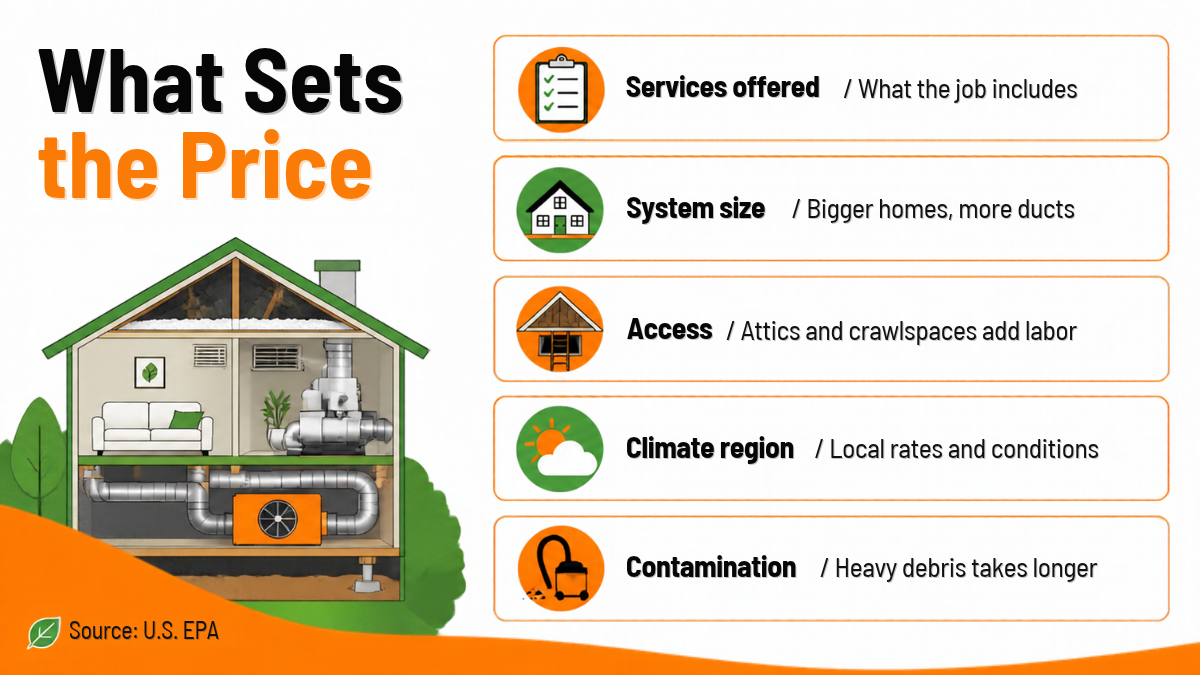
- Size: A bigger home usually means more ducts, more registers, and more hours. Some companies price by square foot, and the usual range is about $0.15 to $0.35 per square foot.
- Access: Ducts in a tight attic or crawlspace take longer to reach, and extra labor shows up on the bill.
- Condition: Heavy dust and debris take more time than a light surface layer, and mold changes the job entirely (more on that below).
- Number of systems: A home with two furnaces or an add-on zone is two systems to clean, not one.
- Extras: A dryer vent is a separate duct run, and cost guides usually list it as an add-on, around $140 on average.
If you live near the shore, our post on coastal humidity explains how damp, salty air affects a home, but humidity alone is not a reason to buy a costly package.
How Do Companies Price The Job?
Companies usually charge in one of three ways, and each one hides a different risk. Here’s how.
- Per system. One price for the whole heating and cooling system is the easiest to compare, as long as the written scope says what is covered.
- Per vent or per register. This looks cheap at first, but the total grows with the count, and extras such as the main trunk lines or the furnace housing may be billed on top.
- By the hour. The EPA says that if a company bills hourly, you should ask for an estimate of how many hours or days the job will take. Fixr puts labor at roughly $90 to $130 an hour, and says most jobs take about three to six hours, so a quote that promises a whole house in under an hour deserves a question.
Whichever model you meet, ask for the price in writing with the scope attached. Two quotes can look $200 apart and still describe very different amounts of work.
What Should A Full Cleaning Include?
A real cleaning treats the whole system, not just the vents you can see. The EPA lists the parts of a heating and cooling system as the supply and return ducts, registers, coils, drain pans, the fan, and the air handler housing, and says a provider should agree to clean all of the components and be qualified to do so.
In practice, a quote should say:
- Which parts of the system will be cleaned, and by what method.
- That access ports will be opened so the whole system can be cleaned and inspected afterward.
- That carpet and furniture will be protected during the work.
- Whether the dryer vent is included or priced separately (our post on preventing dryer fires explains why it deserves its own line).
If you get a quote that says only “whole house duct cleaning” and nothing else, ask the company to list what that means. The answer tells you more than the price does. Our service page for air duct cleaning shows how we describe the work, and the same questions apply to any company you hire.
Why Is A Very Low Price A Red Flag?
Everyone likes a deal, and low prices exist in this trade for a reason. NADCA, the industry association, warns homeowners to beware of coupons with an ultra-low price for “whole house air duct cleaning.”
The pattern is easy to spot. A coupon gets you in the door, then the technician finds “mold,” “contamination,” or a “needed upgrade” that costs far more than the advertised price.
Watch for these signs:
- A price that is far below every other quote you have, with no written scope.
- Pressure to decide on the spot, or a technician who arrives unannounced.
- A request for a large payment up front, or for full payment before the work is done.
- New charges that appear after the visit starts and are not put in writing.
None of this means that a low quote is always a scam. It means a low number needs a short list of questions: what is cleaned, how long will it take, and what will cost extra.
A reliable company answers them without fuss.
What Extras Should You Question?
Some add-ons are legitimate. Others are upsells that you should understand before you agree. Three of them deserve a closer look.
Sweeping health claims come first. The agency advises you not to hire a cleaner who makes broad claims about the health benefits of duct cleaning, because such claims are unsubstantiated. Cleaning can make sense when ducts are visibly dirty, but a promise that it will cure allergies or asthma should make you pause.
Chemical treatments are next. The agency says not to allow chemical biocides or treatments unless you fully understand the pros and cons, and not to allow sealants except in unusual circumstances where other options are not feasible. If a company recommends either, ask for the reason in writing, and get a second opinion before you pay.
Mold is the third. Real, substantial mold growth inside metal ducts is one of the agency’s reasons to clean, but the fix involves finding and stopping the moisture first, and cost guides put mold remediation at roughly $1,000 to $5,000, separate from a standard cleaning. Take a photo of anything a technician says is mold, and ask where the moisture is coming from.
How Do You Compare Estimates Fairly?
The simplest rule comes straight from the EPA: talk to at least three service providers and get written estimates before you decide whether to clean at all. Then put the quotes side by side, not just the total.
- Scope: Does each one list the same components and the same dryer vent work?
- Billing method: Per system, per vent or by the hour, and how many hours are expected?
- Written agreement: Does it state the total cost and scope before work begins?
- Payment terms: Is there a small deposit, or a demand for the full amount up front?
- Credentials and contact details: Does the company have a real website, phone number, and address you can check?
REMEMBER TO…

If you need help vetting a company, our guide to finding the right pro covers the questions to ask, and it explains what to ask before you sign.
Does The Cost Change How Often You Should Clean?
It should change how you think about it. Because the EPA does not recommend routine duct cleaning, only cleaning as needed, you are not signing up for a yearly bill. You are paying when there is a reason (read our guide for more), such as visible mold, vermin, or heavy dust and debris.
Our post on how often ducts need cleaning and when to actually clean them walks through those triggers and what you can check yourself between cleanings, which is the cheapest step of all.
A Fair Price Is A Clear Price
A fair air duct cleaning cost is one you can explain line by line. Expect a national range of a few hundred dollars for a typical home; expect it to vary with size, access, and condition, and be wary of any number that is too good to be true.
If you want a written estimate with the scope spelled out, get in touch and tell us about your system.
Frequently Asked Questions
How much does it cost to clean air ducts in a house?
Most national guides put it around $300 to $700 for a typical home. Your quote depends on system size, access, condition, and extras such as a dryer vent.
Is cheap air duct cleaning legit?
Be careful. Industry groups warn about ultra-low whole-house coupons, so ask what the price covers, how long it takes, and get any added charges in writing first.
Do you pay per vent or per system for duct cleaning?
Both models exist. Per-system pricing is easier to compare, while per-vent pricing can grow with the count, so always ask what the quoted total includes in writing.
How long does air duct cleaning take?
Most jobs take about three to six hours, according to national cost guides. Larger systems, hard-to-reach ducts, and added dryer vent work can run longer than that.