

“How often should air ducts be cleaned?”
It’s a question worth pondering when you’ve just hit the “Ok, now what?” right after your first clean.
Well, there is no fixed schedule. The EPA does not recommend a routine duct cleaning, but only cleaning as needed.
You see, the duct cleaning industry’s trade group, NADCA, suggests a yearly inspection and a full cleaning every 4 to 5 years, with pets, allergies, and smoking changing that interval. Although the two views overlap more than they seem.
So how to actually expedite the cleaning process yourself? Continue reading to find out.
The sections below explain both positions, the situations that justify cleaning sooner, what you can check yourself, and how to hire a company without being oversold.
TL;DR
-
- The EPA does not recommend routine duct cleaning, only cleaning when there is a specific problem.
- The industry group NADCA suggests a yearly inspection and a full cleaning every 4 to 5 years.
- Visible mold, vermin, heavy dust, and water damage are reasons to act sooner than any schedule.
- Get at least three written estimates, and walk away from anyone selling sweeping health claims.
What Does The EPA Say About How Often To Clean Air Ducts?
As previously mentioned, the EPA does not recommend that air ducts be cleaned routinely, only as needed.
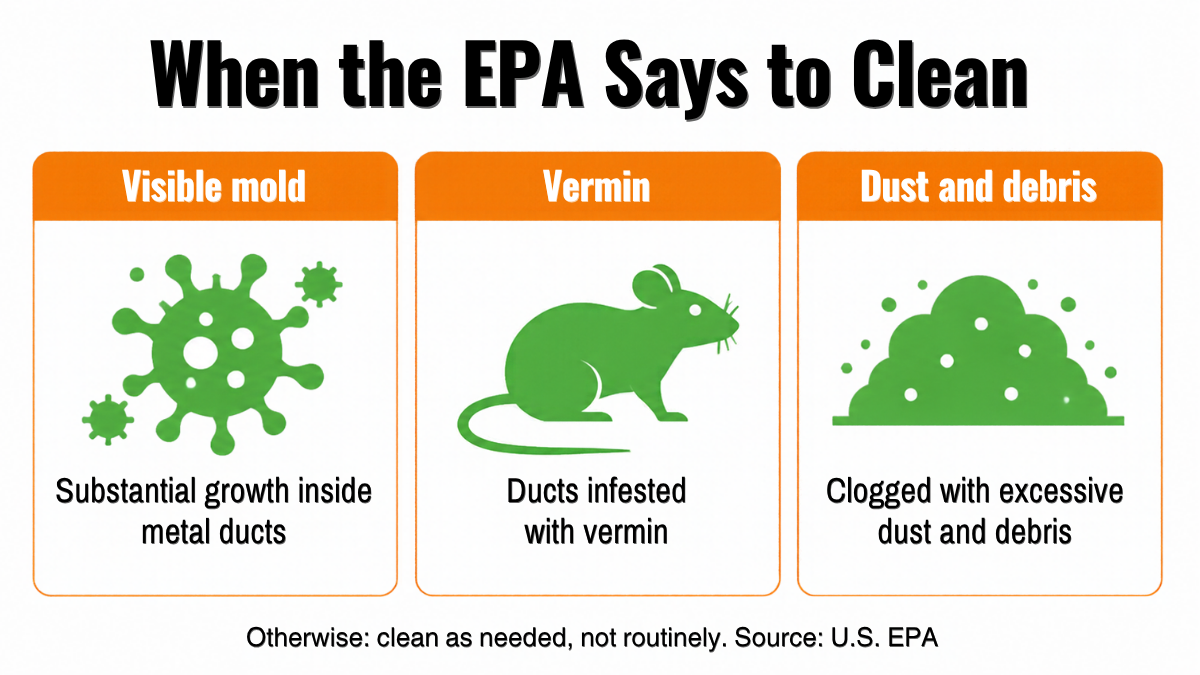
It lists three situations where cleaning may be warranted:
-
- Substantial visible mold growth inside hard surface ducts such as sheet metal.
- Ducts infested with vermin.
- Ducts clogged with excessive amounts of dust and debris.
Outside those cases, a light amount of household dust in your ducts is normal.
Duct cleaning has also never been shown to actually prevent health problems. That does not mean cleaning is never worth doing.
It means the reason should be a real problem you can see, not a promise about the air in your home.
What Do Duct Cleaners Recommend Instead?
As previously mentioned, NADCA, the trade association for duct cleaning companies, says HVAC systems should be inspected yearly, and a complete system cleaning performed every 4 to 5 years.
The group adds that the interval may vary with factors such as pets, occupants with asthma or allergies, and indoor smoking. That post dates from 2016, and many contractor sites quote “3 to 5 years” instead, so don’t be surprised to see different numbers.
Its members clean ducts for a living, so treat any calendar as a guide, not a rule. The two positions fit together better than they look.
A yearly look at the system is a reasonable habit, and the EPA’s triggers tell you when a cleaning is justified.
But When Should You Actually Clean Air Ducts?
Some situations should override the calendar. Here are a few, including the previous recommendations:
-
- Visible mold. This one’s obvious, as substantial growth inside metal ducts is a trigger for cleaning. Cleaning removes the growth but not its cause, so find the source of the moisture first.
- Vermin. Ducts that are infested with pests need attention right away.
- Heavy dust and debris. If years of neglect or a renovation left the ducts clogged with dust, that is the debris trigger, and the schedule no longer matters.
- Water damage. Repair leaks promptly. If insulated ducts get wet or moldy, the insulation cannot be effectively cleaned and should be removed and replaced, so a cleaning alone is not the fix.
- Pets, allergies, and smoking. These are the factors that change the interval, so homes with them should expect to sit on the shorter side of any range.
Does The Type Of Duct Matter?
Yes, because not every duct can be cleaned the same way. The mold trigger in the guidance is written for hard-surface ducts such as sheet metal. Insulated ducts are different. Once the insulation gets wet or moldy, it cannot be effectively cleaned and should be replaced.
Fiberglass duct board raises a separate question about products, since none are currently registered as biocides for it.
If you do not know what your ducts are made of, find out before anyone quotes a job. A company that cannot tell you what it is cleaning, or what it plans to apply inside, is a good reason to keep shopping.
Air Duct Cleaning Frequency By Situation
Here is a practical way to read the guidance for your own home.
| Situation | A Sensible Approach | Why |
|---|---|---|
| Nothing wrong, no special factors | Inspect yearly and clean only if a trigger appears | Both guidelines agree |
| Pets, smoking or allergies at home | Inspect yearly and expect a shorter interval | Listed factors |
| Visible mold, vermin, or clogged ducts | Clean now, after fixing the cause | Listed triggers |
| Leak or water damage | Repair first and replace wet insulation | Moisture problem |
| New home or major renovation | Check for heavy dust and clean if ducts are clogged | Debris trigger |
What Can You Check Yourself Between Cleanings?
You can do a basic check without taking anything apart. Turn the system off, take a flashlight, and look into the registers and returns for heavy dust, debris, droppings, or anything that looks like mold. Look around the vents and along any visible ductwork for dampness, stains, or a musty smell, since moisture is what turns dust into a mold problem.
Don’t scrape or spray inside the ducts yourself. If you see something that worries you, photograph it. Photos make it much easier to compare estimates and to judge whether a company is describing what is really there.
Remember to…

And make sure to follow our guide on the signs you need air duct cleaning to know when you actually need cleaning.
How Do You Hire A Duct Cleaner Without Being Oversold?
The EPA’s advice is simple. Talk to at least three different service providers and get written estimates. Do not hire duct cleaners who make sweeping claims about the health benefits, because the evidence does not support them. Ask three more questions before you agree to anything:
-
- Which method will you use? Steam cleaning and other methods involving moisture should not be used on any kind of ductwork.
- Will you use sealants? Sealants should not be permitted except under unusual circumstances.
- Will you apply biocides? No products are currently registered as biocides for use on fiberglass duct board, so ask what product and why.
The same habits help when you hire for a dryer vent. Our guide to finding the right pro covers what to ask.
Does This Advice Cover Dryer Vents?
No. Everything above is about heating and cooling ducts, and it should not be applied to a dryer vent, which is a separate system with its own risks. We cover those in our post on preventing dryer fires and how often you should clean them.
Does Humid Weather Change The Answer?
In New Jersey, the main effect is moisture. Humid summers and any leak give mold what it needs, and the EPA says to dry damp items within 24 to 48 hours, because in most cases mold will not grow if they are dried in that window.
Wet duct insulation is a problem to take seriously. Our post on how coastal humidity affects a New Jersey home shows the same moisture issues at work indoors.
When Should You Call A Professional?
Call a professional when you see mold, signs of pests, or ducts clogged with dust, when there has been water damage, or when you are not sure what you are looking at. A good company should show you the problem and explain the fix without leaning on health claims.
If you want someone to look at your system, our air duct cleaning service is one option, and you can tell us what you have found and when the system was last cleaned.
Remember To Inspect Yearly And Clean When Something Calls For It
Air ducts do not need cleaning on a fixed calendar. They need a regular look and a real reason. Check the registers once a year, act fast on mold, pests, or water damage, and get written estimates before you agree to any work.
If you would like a second opinion, get in touch.
Frequently Asked Questions
Is Routine Air Duct Cleaning Necessary?
No. The EPA does not recommend cleaning air ducts routinely, only as needed, such as when there is visible mold, vermin, or ducts clogged with dust and debris. Read our guide here to learn more.
How Often Does NADCA Say to Clean Air Ducts?
NADCA says to inspect HVAC systems yearly and do a complete cleaning every 4 to 5 years, with pets, allergies, and smoking changing that interval.
Does Air Duct Cleaning Improve Your Health?
Not proven. Duct cleaning has never been shown to actually prevent health problems, and a light amount of household dust in your ducts is normal.
Can You Steam Clean Air Ducts?
No. Steam cleaning and other methods involving moisture should not be used on any kind of ductwork, so ask any company which method it will use.