


The towels are still damp. Again.
You hit Start one more time, tell yourself the dryer is just getting old, and go back to folding.
Reads familiar? Well, the machine may be fine. The problem could be the duct behind it, slowly narrowing every time lint gets past the filter.
So, how often should you clean a dryer vent?
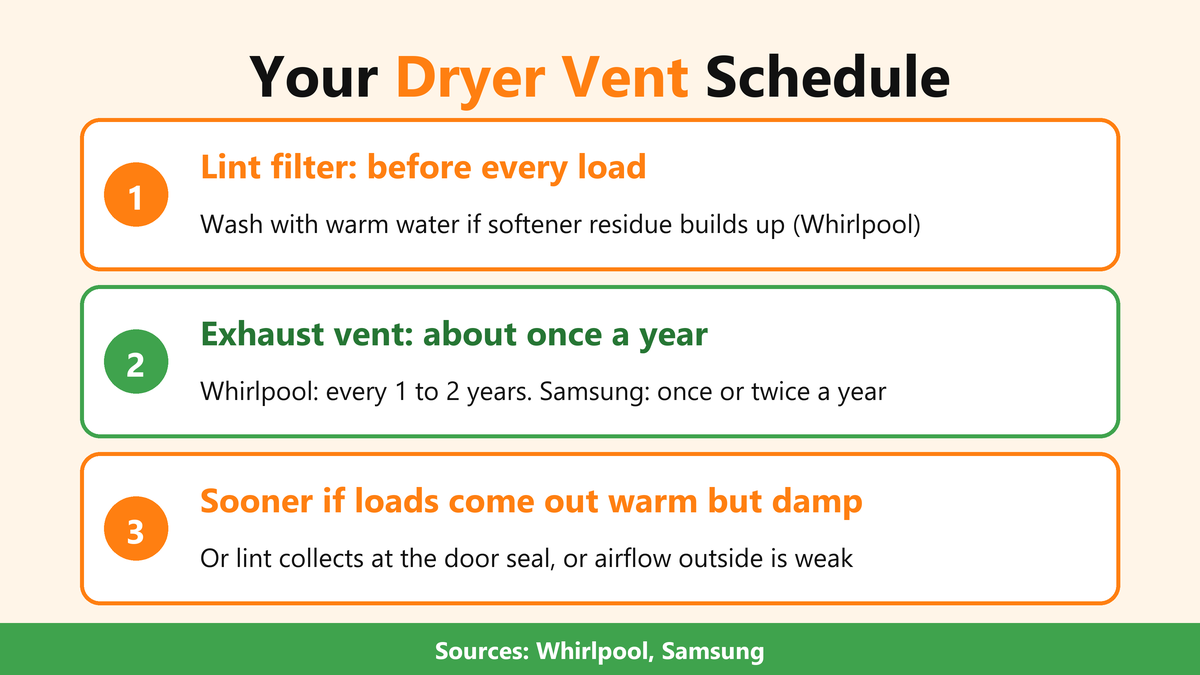
Well, for starters, empty the lint filter before every load, and clean the vent itself at least once a year as a safe default.
You see, the two big manufacturers we checked say every one to two years (Whirlpool) and once or twice a year (Samsung), so your own manual is the final word. So, clean it sooner if your loads come out warm but damp, or if the vent is long, bent, or made of foil.
This blog talks more about how to tell which schedule fits your house. So keep reading to find out.
TL;DR
- Empty the lint filter before every load, and clean the exhaust vent at least once a year unless your manual says otherwise.
- Whirlpool says every one to two years, and Samsung says once or twice a year, so check your own model.
- Damp loads, lint around the door seal, or weak airflow outside mean the vent needs attention now.
- Replace plastic or foil accordion ducts with rigid or semi-rigid metal instead of just cleaning them.
What Is The Short Answer On Dryer Vent Cleaning Frequency?
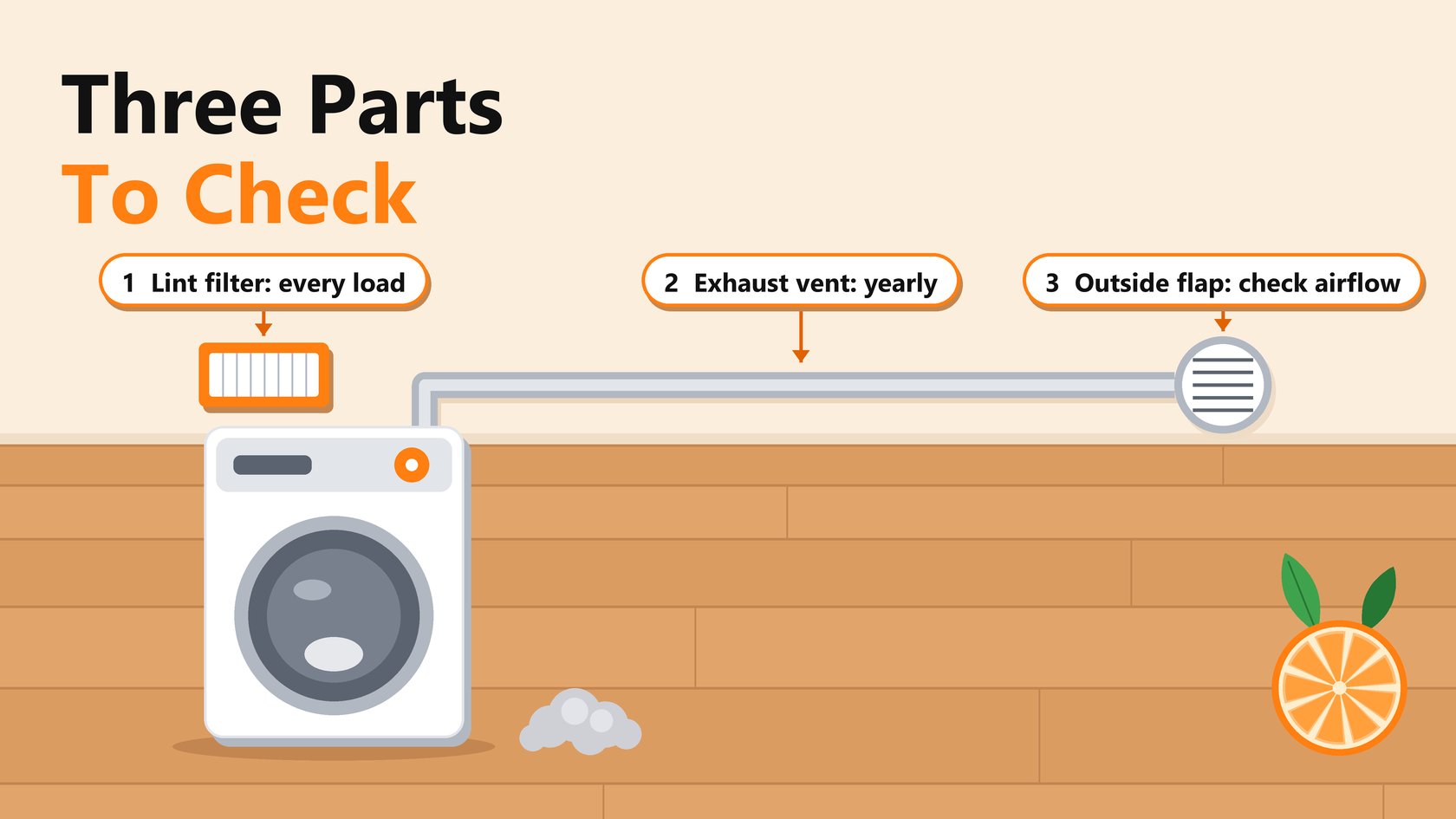
There are two jobs here, and they run on very different clocks. The lint filter is a before-every-load job. The exhaust vent, the duct that carries hot, damp air from the back of the dryer to the outside, is a calendar job.
For the vent, the published advice is a range rather than a single number.
Whirlpool says its exhaust vent must be cleaned every one to two years. Samsung says its vent should be cleaned or replaced at least once or twice a year.
Those two ranges overlap at about once a year, which is why once a year is a sensible starting point for most homes. If your manual gives a different interval, follow the manual.
Here is how the two manufacturers line up side by side:
| What | Whirlpool | Samsung |
|---|---|---|
| Lint filter | Empty before every load | Not covered on the page we checked |
| Exhaust vent | Every one to two years | At least once or twice a year |
| Duct material | Rigid or semi-rigid metal | Rigid |
| Replace instead of clean | Avoid plastic or foil accordion ducts | When the inside lining is no longer visible |
If your dryer is a different brand, look in its use and care guide for the same four lines. The numbers are often close, but the model in your laundry room is the one that counts.
The reason to bother is simple. The Fire Administration lists failure to clean as the leading factor in the ignition of home clothes dryer fires, at 31% in 2018 to 2020. Lint is dry, light, and flammable, and a dryer is a heat source.
Our post on preventing dryer fires goes deeper on that risk.
So just remember to save the below infographic in case you forget.
What Should You Clean Every Load, And What Can Wait?
Everything inside the machine’s reach is a per-load job. Whirlpool says to empty the lint filter before every load, and that is the one habit that keeps most lint out of the duct in the first place.
Once in a while, the filter itself needs a wash. Softener sheets can leave a film on the mesh, and a film blocks airflow even when the filter looks clean. The advice is to wash it with warm water and a soft brush, then dry it thoroughly before putting it back.
The vent itself can wait for its schedule, but it can’t wait forever. A clean filter slows the buildup in the duct. It doesn’t stop it, because fine lint still slips past, so the duct and the outside flap need their own turn.
What Makes You Clean The Vent More Often?
A yearly schedule is a baseline, not a promise. A few things push the vent toward the shorter end of the range.
- A long or bent run. Whirlpool notes that many dryers perform best with a total equivalent vent length under 35 feet, and that each 90-degree elbow adds resistance. More resistance means lint settles faster.
- The wrong duct material. The same page says to use rigid or semi-rigid metal venting and to avoid plastic or foil accordion-style ducts. Samsung also advises rigid ventilation. Foil accordion ducts also give lint more places to catch.
- Heavy use. It is plain common sense that more loads push more lint through the duct, so a busy laundry room earns a shorter interval than a spare one.
- Symptoms. If the dryer is telling you something is wrong, believe it. The next section covers the signs.
If your vent checks several of these boxes, do not wait out the full two years. Clean it once a year, or sooner, and consider fixing the layout.
What Are The Signs You Can’t Wait For Your Next Cleaning?
Calendars are guides, and symptoms win. Three signs from Whirlpool’s own troubleshooting page are worth memorizing:
- Loads come out warm but damp after a full cycle.
- Lint collects around the door seal or the lint housing.
- Airflow at the outside vent feels weak while the dryer runs.
Some Samsung dryers add a warning of their own. A Vent Check Sensor icon lights when the ductwork is about 60% blocked, and it blinks after a cycle when the blockage passes 80%. On a sensor-dry cycle, a severe blockage can even make the cycle run indefinitely.
You don’t need a special tool to check the outside flap. Run the dryer, go outside, and put your hand near the vent cap. Strong, warm air means the path is mostly open. A weak trickle means it isn’t.
Can You Clean The Vent Yourself?
Sure, sometimes.
A short, straight run is a reasonable weekend job with a brush kit. A long run, a roof vent, or an upstairs laundry room is another story, because the brush may not reach the whole duct, and a half-cleaned duct can look fine from both ends.
Our guide to finding the right pro explains what separates a real vent specialist from someone who only clears the outside cap, and what to ask before you book.
When Should You Replace The Vent Instead Of Cleaning It?
Sometimes cleaning is the wrong fix.
Samsung says that when the inside lining of the vent is no longer visible because of blockage, replacing it is strongly recommended. And if your duct is plastic or foil accordion-style, Whirlpool’s advice is to avoid that material altogether, so swapping it for rigid or semi-rigid metal is a better use of money than cleaning it again and again.
A replacement is also the moment to fix the layout. Shorten the run if you can, and remove unnecessary elbows. A straighter path helps every cleaning last longer.
Where Does Your Air Duct Cleaning Fit In?
Your dryer vent and your home’s heating and cooling ducts are two separate systems, with different rules. Dryer vents follow the manufacturer’s schedule, while the EPA says air ducts should be cleaned only as needed.
If you are curious about the second one, our post on how often ducts need cleaning covers it.
Make It A Habit, Not A Scramble
Put the filter on autopilot and the vent on the calendar. Empty the filter before every load, pick a month for the vent, and let a symptom move that date up.
If you would rather hand it off, our dryer vent cleaning service can take care of it, and we are happy to answer questions first.
Frequently Asked Questions
Is cleaning the lint trap enough?
No. Empty the lint filter before every load, but fine lint still reaches the duct. The exhaust vent needs its own cleaning, at least once a year for most homes.
How do you know when your dryer vent is clogged?
Watch for loads that are warm but damp after a full cycle, lint around the door seal, or weak airflow at the outside vent while the dryer runs.
Should you use a foil accordion vent?
Avoid it. Whirlpool recommends rigid or semi-rigid metal venting and says to skip plastic or foil accordion-style ducts, which give lint more places to catch.
Can a clogged dryer vent cause a fire?
Yes. Failure to clean was the leading factor in the ignition of home clothes dryer fires from 2018 to 2020, at 31%, according to the U.S. Fire Administration.