

Picture one fine day, you blotted the spot. You scrubbed it, maybe sprayed on an odor eliminator, and for a day or two the carpet seemed fine. Then the smell came back, sometimes worse than before, especially after a humid afternoon or a rainy week.
You ask yourself…”Oh no, not again, why does this happen to me?”
Well, that pattern is pretty common, and it has a straightforward explanation. It is that cleaning the surface of the carpet doesn’t always remove urine that has already worked its way into the layers underneath it, and dog urine doesn’t just sit on top of carpet fibers.
Depending on how much urine there was, how long it sat, and how the carpet is constructed, and unlike a mattress, it can travel down through the fibers, into the backing, and sometimes into the padding beneath.
So how to get rid of all that smell? This article is all about that and explains why it happens, how to treat urine correctly at each stage, what actually works (and what just masks the smell for a while), and how to tell when a DIY approach has reached its limit.
Keep reading…
TL; DR
- Urine odor returns when residue remains.
- Blot accidents quickly to limit absorption.
- Treat affected areas according to product directions.
- Persistent odors may require professional extraction.
Why Does Dog Urine Smell Keep Coming Back?
Understand first that carpets are built in layers. Fiber on top, a backing layer that holds the fibers in place, and a cushioned pad underneath that sits on the subfloor. Now, urine follows gravity. A small amount from a quick accident that gets blotted right away may never travel past the fibers.
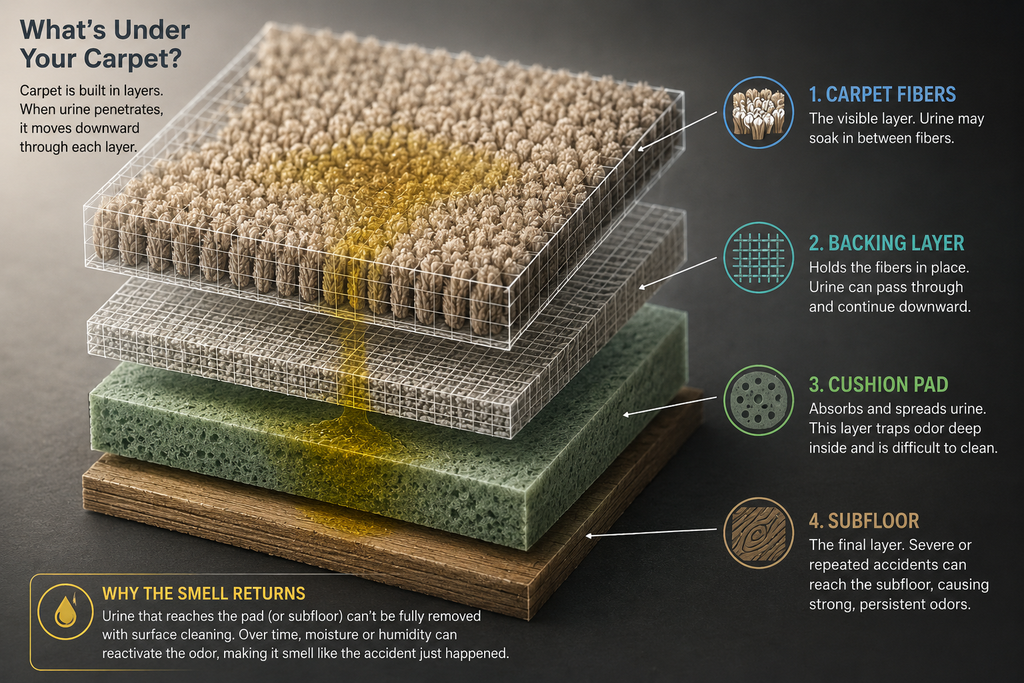
A larger puddle, a spot that sits for a while before anyone notices, or repeated accidents in the same corner have a much easier path down through the backing and into the padding, where it spreads out and has nowhere left to go.
So, as urine dries, the liquid portion evaporates, but the urea, uric acid, and salts in it don’t disappear; they crystallize and remain behind. Those crystals are largely odorless while dry, which is part of why a carpet can smell fine on a cool, dry day and then start smelling again once humidity rises.
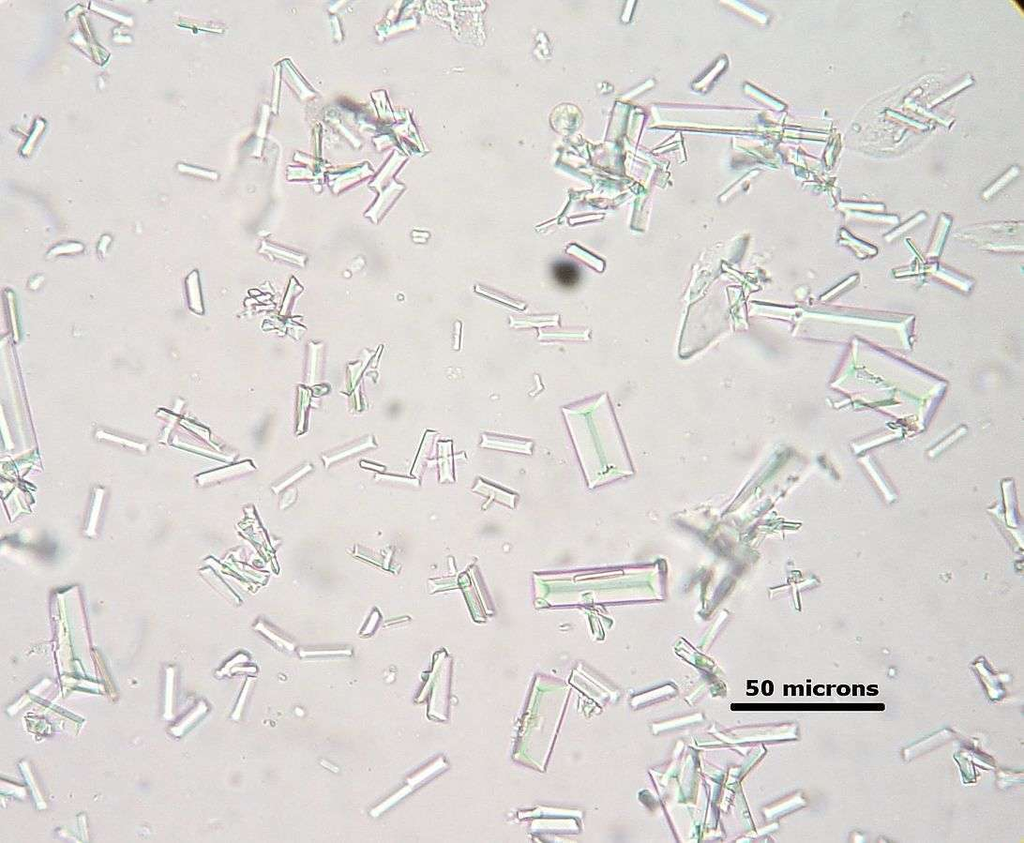
Moisture in the air reactivates the crystals and releases odor-causing compounds, which is why homeowners often notice pet odor getting stronger on humid days, after mopping nearby, or after steam cleaning without proper extraction.
This also explains why many store-bought sprays only offer temporary relief.
You see, a product built around fragrance is designed to cover the smell in the air, not to break down the residue sitting in the carpet system. Once the fragrance fades, the underlying source is still there.
But even after cleaning, the smell may not go away. Keep reading to see why.
Why Does My Carpet Smell Like Dog Urine After Cleaning?
In most cases, the smell returns because the cleaning addressed what was visible on the surface but not the urine residue that had already reached the backing, padding, or, in more extreme cases, the subfloor.
Surface cleaning can look successful immediately afterward while leaving the actual source of the odor untouched.
So…
How To Get Dog Urine Smell Out Of Carpet?
For a recent accident, speed and technique both matter. Here’s the right sequence.
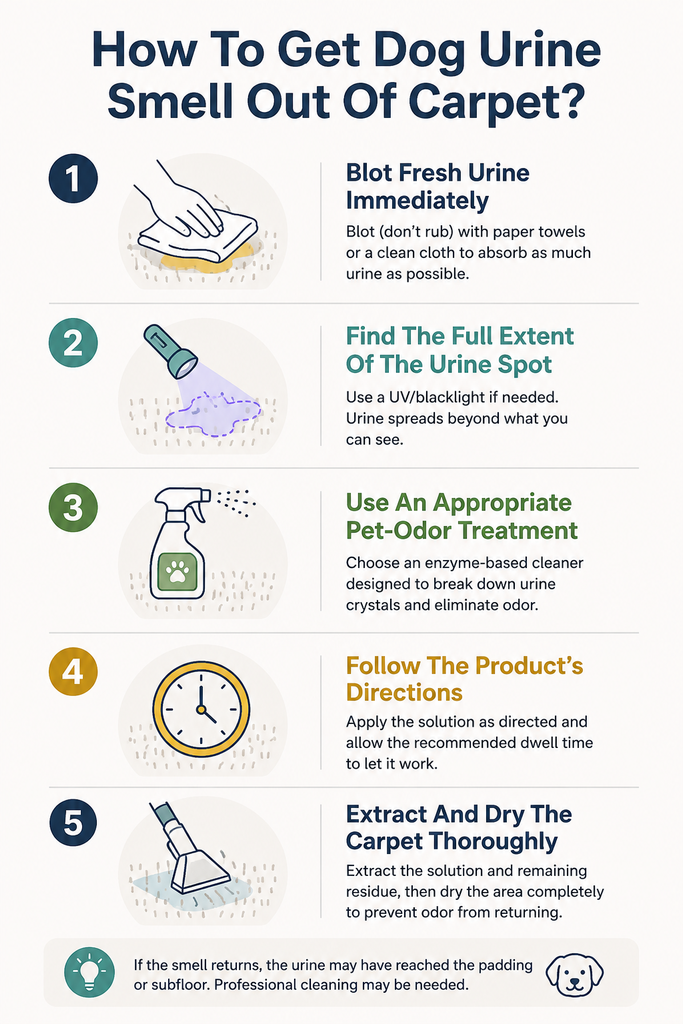
1. Blot Fresh Urine Immediately
Grab paper towels or a clean cloth and press down firmly, working from the outside of the spot toward the center so you’re not spreading it outward. Blot, don’t rub or scrub. Scrubbing pushes urine deeper into the fibers and can damage them.
Keep switching to dry sections of towel and, if you can, stand on a folded towel over the spot for extra absorption. The goal is to pull out as much liquid as possible before it has a chance to travel downward.
2. Find The Full Extent Of The Urine Spot
Urine often spreads wider underneath the carpet than it appears on the surface, since it moves outward as it soaks down through the backing. A UV or blacklight can help locate dried or older urine spots that aren’t visible under normal lighting, since the residue tends to fluoresce.
It’s a useful screening tool, not a perfect one, as it can also react to other substances, so treat what it shows you as a starting point rather than a diagnosis.
3. Use An Appropriate Pet-Odor Treatment
A product formulated specifically for pet urine, rather than a general carpet cleaner or an air freshener, is generally the better choice. Many pet-odor products rely on enzymes or bacterial cultures that are designed to break down the organic compounds in urine rather than simply cover the smell.
Follow the product label, and avoid combining multiple cleaning products on the same spot; mixing chemicals, particularly bleach and ammonia-based products, can create dangerous fumes and should never be attempted.
4. Follow The Product’s Directions
Dwell time! is how long a product needs to sit on the carpet before it’s wiped up or extracted; it varies by brand and formulation. Enzymatic treatments in particular often need time to work, sometimes an hour or more, and wiping them up too soon can undercut their effectiveness.
Read the label rather than assuming every product behaves the same way.
5. Extract And Dry The Carpet Thoroughly
Once the treatment has had time to work, extract as much moisture as you can, rather than letting the carpet air-dry with the solution still inside. A wet or dry vacuum or carpet extractor pulls out both the cleaning solution and the loosened residue. Getting the area dry quickly also matters, since a damp carpet that stays wet for an extended period creates conditions where odor and, in some cases, mold can develop.
For a single fresh accident that’s been treated properly, this is often enough. For anything larger, older, or repeated, it may not be, which is where DIY cleaning tends to hit its limits.
Although things may not be in your favor when DIYing your carpet cleansing process. So…
Why DIY Carpet Cleaning Sometimes Doesn’t Remove Dog Urine Odor?
There’s a real difference between cleaning the surface of a carpet and removing the actual source of an odor. A rented carpet cleaner or a spray-and-blot routine is generally built to lift dirt and residue from the top layer of carpet fibers. That’s effective for a fresh, small accident that hasn’t had time to travel anywhere.
The problem shows up with urine that has already reached the backing or padding.
Household extractors typically don’t have the suction power to pull moisture and residue back out of a carpet pad, and pouring more liquid onto the surface to “flush it out” can actually push contamination further down and spread it laterally through the padding, which is porous and holds onto both moisture and odor.
In cases involving repeated accidents in the same spot, an older stain that was never fully treated, or a large volume of urine from a bigger dog, there’s a reasonable chance the contamination extends beyond what surface cleaning can reach, potentially into the padding, and in more severe or long-standing cases, down to the subfloor.
Not every case goes that deep; it depends heavily on the amount of urine, how quickly it was addressed, and how the carpet is constructed. But when a carpet has been cleaned properly, and the smell still returns, that’s usually the reason.
Can Baking Soda Or Vinegar Remove Dog Urine Smell?
These are two of the most common home remedies, and neither one is useless, but neither is a complete fix for anything beyond a very light, fresh spot.
Here’s what you should ask yourself when asking…
1. Does Baking Soda Remove Dog Pee Smell?
Baking soda can absorb some odor from the surface and air, which is why sprinkling it on a carpet and vacuuming it up later can make a room smell better temporarily. It doesn’t break down the uric acid crystals that cause the odor to return, so it works better as a supplement to proper cleaning than as a stand-alone solution for anything beyond a very minor, fresh spot.
2. Does Vinegar Get Dog Urine Smell Out Of Carpet?
Vinegar is acidic and can help neutralize some of the ammonia smell in fresh urine, and some people use a diluted vinegar solution as part of a DIY treatment. It isn’t formulated to break down uric acid crystals the way an enzymatic cleaner is, so it tends to offer partial, temporary relief rather than eliminating the source, particularly on older or larger stains.
3. Should You Use Bleach Or Ammonia On Dog Urine?
No. Urine already contains ammonia, and some dogs may even be drawn back to a spot that’s been cleaned with ammonia-based products because the smell resembles urine to them.
More importantly, never mix bleach with ammonia or with any cleaner that contains ammonia; combining the two produces toxic chloramine gas, which is dangerous to breathe in an enclosed room.
If you’re not sure what’s in a product, don’t combine it with anything else.
Speaking of dogs, there are times when they won’t let go of the carpet they once saw as beautiful (before cleaning). Let’s discuss why.
Why Does My Dog Keep Going Back To The Same Carpet Spot?
Dogs have a sense of smell that’s vastly more sensitive than a human’s, and they can often detect residual urine odor in a spot long after it’s undetectable to a person. That residual scent can act as a signal that tells a dog “this is a bathroom spot,” which is part of why pets frequently return to the same area even after it’s been cleaned.
Thoroughly removing the odor, not just the visible stain, is one part of breaking that cycle. It’s not a guaranteed fix on its own. Repeated inappropriate urination can also stem from behavioral issues, incomplete house training, anxiety, or an underlying medical condition, so if the accidents continue after the odor has genuinely been eliminated, it’s worth talking with a veterinarian or trainer alongside addressing the carpet itself.
Now that you understand what’s going on with DIY cleaning, it’s time to know when to call up a professional carpet cleaner for your carpet cleaning needs.
When Should You Call a Professional Carpet Cleaner?
DIY treatment handles a lot of situations well, particularly fresh, small, isolated accidents. It’s worth bringing in a professional when:
- The odor returns after you’ve already cleaned and treated the spot.
- The urine is old, dried, or of unknown age.
- There have been multiple accidents in the same general area.
- The affected area is large.
- You can smell urine but can’t pinpoint where it’s coming from.
- The padding may be affected, or the carpet has stayed damp longer than expected after cleaning.
- The odor becomes noticeably stronger in humid weather.
- You’ve tried more than one DIY product without lasting results.
Any one of these is a reasonable signal that the contamination has moved beyond what a household cleaner or rented extractor can reach.
Professional Pet Stain & Odor Removal From Citrus-A-Peel
When DIY cleaning has been tried, and the smell keeps coming back, that’s usually a sign the problem isn’t the cleaning method; it’s what’s still sitting below the surface. Citrus-A-Peel’s approach to pet stains and odors follows a straightforward process: identify the full extent of the contamination, treat it with products suited to the type and age of the stain, extract thoroughly, and deodorize.
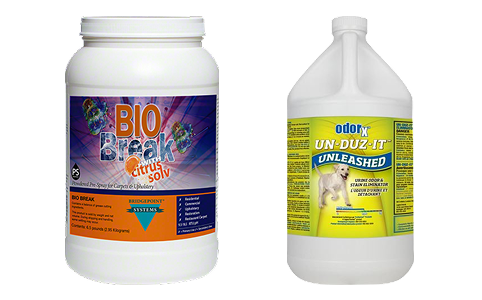
For pet-related contamination, Citrus-A-Peel uses Un-Duz-It Unleashed, an enzyme-based product built to target the odor-causing proteins in pet accidents, alongside general cleaning products like Bio-Break, a citrus-based preconditioner that helps break down grime and oils in carpet and upholstery fibers before extraction.
The goal isn’t to mask odor with fragrance; it’s to treat the actual source of the contamination and remove it with professional extraction equipment designed to pull moisture and residue out of carpet more thoroughly than a rental unit or a spray bottle can.
If you’ve cleaned a spot more than once and the smell keeps returning, or you have an older stain you can smell but can’t locate, Pet Stain & Odor Removal can help identify what’s actually going on beneath the surface and whether the carpet, the padding, or both need attention.
For general maintenance and non-pet-related cleaning needs, Carpet & Upholstery Cleaning covers Citrus-A-Peel’s broader carpet care services.
Frequently Asked Questions
How do you get old dog urine smell out of carpet?
Locate the full extent of the stain, ideally with a UV light since older urine is rarely visible to the eye once dry, then apply an enzymatic pet-odor treatment with adequate dwell time. Older, more concentrated residue often needs more than one treatment, and may require professional extraction if it has reached the padding.
Can baking soda remove dog urine smell from carpet?
It can absorb some surface odor temporarily, but it doesn’t break down the uric acid crystals causing the smell, so it isn’t a complete solution on its own.
Does vinegar get dog pee smell out of carpet?
Diluted vinegar can help neutralize some of the ammonia smell in a fresh accident, but it isn’t formulated to break down dried uric acid, so results are typically partial and temporary rather than a full fix.
Can dog urine soak into carpet padding?
Yes. Depending on the volume of urine and how quickly it’s cleaned up, it can pass through the carpet fibers and backing into the padding underneath, and in more severe cases, reach the subfloor.
How can I find old dog urine stains in carpet?
A UV or blacklight is the most practical DIY tool, since dried urine tends to fluoresce under it even when it’s invisible in normal light. It’s a helpful starting point, though not a perfect diagnostic; other substances can also react to UV light.